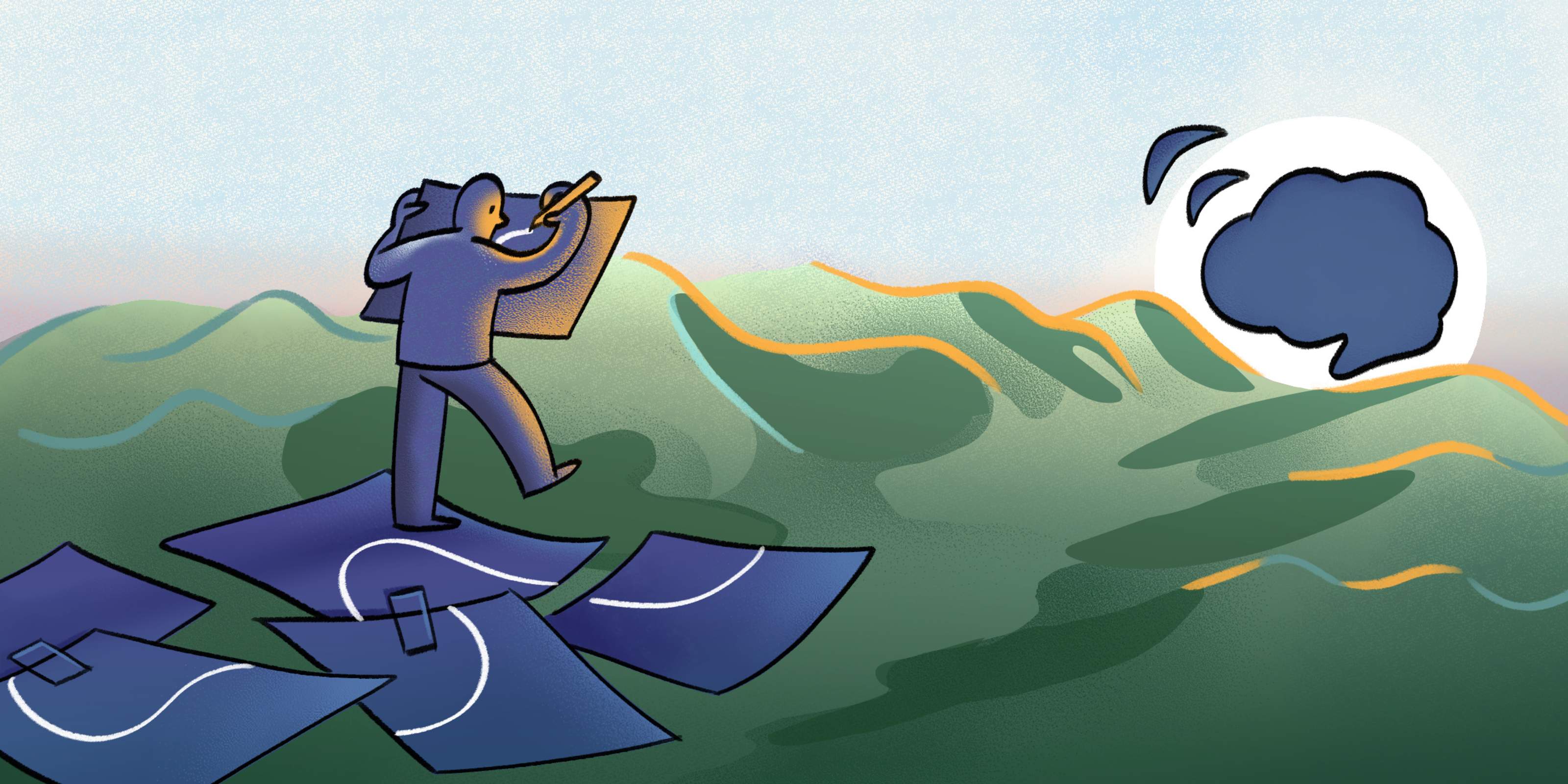
The workplace has often been confusing to me. Long meetings usually seem neverending and require boatloads of coffee to endure. I’ve also found myself asking for more clarification than others when expectations weren’t explicit. For a long time, it felt like everyone else had been handed a map to professional life and I hadn't.
For the first 25 years of my life, I thought I was just sort of weird. I was always stressed out. I never quite fit in with peers, coworkers, or family. The things that excited me often seemed strange or uninteresting to everyone else. Eye contact was never my forte. Often it seemed like I could only do one thing well in my life at any given time.
Then I was diagnosed with generalized anxiety disorder. It made sense—I remember in middle school not being able to sleep at night because I was so worried about school the next day. My whole life, there’s been a self-critical voice in my head saying I should be finished with whatever task I was working on or working at a faster pace.
At the same time, some of the ways my brain works have served me well. My pattern recognition skills have proved quite useful in my quality assurance career for finding defects in user interfaces and code. Hyperfocus has helped me untangle some remarkably stubborn problems. Attention to detail and a dash of perfectionism have made me a go-to when the details really matter.
Bring the Real You
During my career, I have worked as a web developer and QA engineer at a handful of companies, including a two-person agency, a startup, a fintech company, and then a Fortune 500 company. Throughout those years, I never quite fit in and kept running into career ceilings that I couldn't explain.
Then I started at Doximity. For the first time, I felt comfortable being myself at work. I felt grateful, respected, and, for the most part, free to just be myself.
When I first heard one of Doximity’s core values "Bring the real you," it sounded like corporate-speak. But the longer I worked at Doximity, the more I realized I actually could. I've never been very good at pretending to be someone else. Over time, as I received positive feedback and watched colleagues show up as themselves, I found myself spending less energy trying to fit in. Somehow at Doximity, being myself brought less friction to my life at work than it had elsewhere. I wear bright colors, band shirts, and goofy socks. I'm very empathetic, especially to newcomers and people who have good hearts but don’t seem to fit in.
For most of my career, I thought those traits were liabilities. Eventually, I came to see many of them differently. I am not sure exactly why Doximity felt different from the places I’d worked before. Maybe it was the people, the culture, or simply finding a workplace where I fit better. What I do know is that many of the traits I once viewed as weaknesses have been strengths here.
Finding Purpose from Diagnosis
After five years at Doximity, I was diagnosed with autism and ADHD. These new diagnoses came as a complete surprise. I had known people with autism and ADHD over the years, but I never recognized myself in them.
Suddenly, certain parts of my life started to make sense. Looking back, I could see connections between experiences that had always been there. Throughout my career, I often felt lonely, even surrounded by an office full of people. At times I felt invisible. Forming close friendships seemed harder for me than it did for others, even when people generally liked me. Small talk at offsites and holiday parties could be exhausting. I spent a lot of energy masking parts of myself to fit in. Sometimes I just needed to be completely alone for a while to recharge.
After I was diagnosed with autism, I realized I wanted to help start a neurodiversity employee resource group (ERG) at Doximity. I wondered whether a neurodiversity ERG could help others find a space to be themselves and learn some of the lessons that took me years to figure out on my own. While my own experience is shaped by autism, ADHD, and anxiety, the ERG isn't focused on any one diagnosis. We hope it will be a welcoming space for anyone who identifies as neurodivergent, is exploring that possibility, or simply wants to learn more.
We took a vote and decided to call our neurodiversity ERG “UnorthoDox.” Because our brains work a little differently and we think, learn, and process the world in different ways than most people. Hence, “UnorthoDox.” We hope to build community, share resources, reduce stigma, and advocate for a workplace that recognizes and values diverse ways of thinking. By doing this, we will help Doximity continue to live out its core value and encourage all Doxers to bring their true selves to work.
Illustration by April Brust